

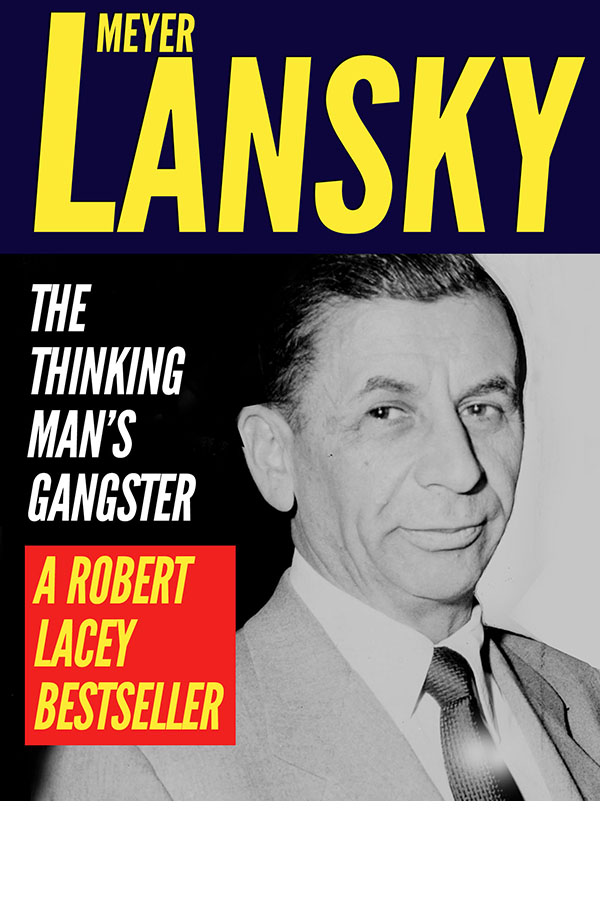



First published in 1991 as Little Man: The Gangster Life of Meyer Lansky, the original text has been revised and updated for this edition by Robert Lacey, and much bonus material added.
They called Meyer Lansky the Godfather of the Godfathers, the Chairman of the Board of the National Crime Syndicate, the Mafia’s banker. They credited him with a personal fortune of $300 million, with having said “We’re bigger than U.S. Steel.” He was portrayed on the screen in The Godfather, Part II as Hyman Roth, dividing up Cuba with his fellow gangsters, and more recently in Boardwalk Empire as himself, played by Anatol Yusef.
If, in the mythology of organized crime, Al Capone symbolized the crude menace of the machine gun and the baseball bat, Meyer Lansky stood for the brains, the sophistication, the hot money, the sheer cleverness of it all. And yet, when it came down to it, no law enforcement official in 60 years could find much to pin on the supposed boss of bosses, and within a few years of Lansky’s death, his crippled son was living on welfare.
Meyer Lansky: The Thinking Man’s Gangster is a book about organized crime unlike any other yet written. In this brilliant biography and social history, Robert Lacey separates the strands of fact and legend in Meyer Lansky’s career, revealing a truth about the gangster life in America that is far more fascinating and dramatic than fiction.
A Jewish immigrant from Russia, Lansky broke into a life of crime running crap games and acting as a shtarke, a strong-arm man for Jewish and Italian gamblers on the Lower East Side of New York. Teaming up with his pals Lucky Luciano and Bugsy Siegel, he graduated to bootlegging. Meyer became the master of the “share-out,” keeping all the figures in his head and dividing up the spoils from smuggled liquor shipments. In the thirties and forties he moved on to illegal gambling, running the classiest casinos around. He invested in modern Las Vegas – though he never really liked the place – and became the gambling consultant to President Batista during Havana’s glory days. In World War II he even acted as a go-between for U.S. Naval Intelligence, paving the way for gangster help to the Allied invasion of Sicily.
Then in 1951 Estes Kefauver’s Senate Crime Committee named Lansky as one of the leaders of organized crime in America, fueling the legend that would eventually destroy him. Cuba’s revolutionary leaders expelled him in 1960 as a corrupting influence. His attempts to go into legitimate business and later to settle in Israel were frustrated by the shadows of his past. His every step was dogged by the FBI and the IRS, as his family disintegrated and his health declined. His death was front-page news, but at the end, his power and wealth were all gone.
Based on dramatic new documentation and firsthand interviews with Lansky’s close friends and business associates, with law enforcement experts, and members of the Lansky family, Meyer Lansky: The Thinking Man’s Gangster is a powerful and irresistible narrative of a man and a way of life never before truly examined. Robert Lacey has written, in this bestselling biography, a groundbreaking exploration of organized crime in America and of our enduring fascination with criminals.
“Daring and well written … it would be criminal not to read it.” People magazine
“I have been a criminal defense lawyer for over 50 years it is no doubt my chosen field that causes this fascination but I have always loved learning about the lives of the gangsters from the Twenties into the Fifties and a special interest in the Jewish gangster like Longy Zwillman Dutch Schultz and the men who made up Murder, Inc. But of all of them Meyer Lansky was the most fascinating.
Robert Lacey’s book is thrilling for the incredible amount of research necessary to produce this intimate look at Lansky’s life, the unknown minute details but also an exposé regarding the truth of Lansky’s millions which in fact whatever he amassed was virtually gone at the end of his life. Despite it being a long topic for a book every page is alive and fascinating. One of the biggest revelations was that J Edgar Hoover and the FBI made him the “accountant for the mob” a man who amassed multi-millions but so much of it was government hype to justify their unending relentless pursuit of him. This is not to deny that after a tough guy youth he grew into a very clever criminal although so much of his brilliance was in contrast to the stupidity of those who allegedly compromised the Mafia. He was basically a gambler, a builder of casinos with a brilliant capacity to compute and retain complex amounts of numbers in his head But gambling was his crime including the skim and tax avoidance. He was never into drugs or prostitution, robbery or fraud which victimized the average person. If you have any interest in the true story of “Little Man” this is the book for you. Robert Lacey keeps the saga of over 70! years of Lansky’s life and times dynamic and moving.” 5★ Amazon review
“I had trouble putting this book down and stayed up late every night I was on vacation reading it. Afterwards, I went back and re-read the last three chapters to get the conclusion straight.
This book was extremely well written giving an almost insider’s look into the world of gangsters from about the 30’s through the 60’s. Although Meyer moved easily in the circles of organized crime, there is no evidence that he was a “made” guy or was personally involved in violence after his youth. Meyer Lansky had a high profile with the public and especially the press which caused J. Edgar Hoover to expend unlimited resources tracking him and attempting to put him in jail. He did not succeed because Meyer was very careful about what laws he broke and how he broke them. His public reputation far exceeded the truth. According to the press he was a very wealthy man. Always aware that the Feds imprisoned Al Capone for tax evasion, Meyer passed on many opportunities to enrich himself and ended up practically destitute. Fortunately, he had many good years living the high life with income from his gambling operations. This is the time before Las Vegas and Atlantic city when the authorities were willing to look the other way.
The writer was greatly helped by access to the files the Israeli’s had on Meyer from his attempt to escape US authorities by becoming an Israeli citizen. His citizenship didn’t happen but in the course of the investigation the US Justice Department sent them almost all of their files. Sealed and difficult to access in the US by Mr. Lacey, the Israeli’s had no problem sharing.
Mr. Lacey spent about a year researching and writing this book interviewing Meyer’s children, widow, nieces and nephews and associates who were willing to talk. I highly recommend it if you are interested in this genre.“ 5★ Amazon review